


Every SaniTap project reaches households through community authorities who agreed the project should exist there in the first place. That agreement is Free, Prior and Informed Consent, the international standard for community consent on interventions that affect people’s lives and livelihoods, and it is the operating principle that runs beneath every stove distributed, every hand pump restored, every piped-water system commissioned and every innovation pilot proposed. If a community does not want a project, or does not want it in the form we have designed it, the project does not proceed there.
This article sets out what FPIC actually requires, where the standard comes from and why it matters, and the concrete way SaniTap applies it across every strand of our work. It is written for procurement teams, ESG reviewers, project finance analysts, and anyone else who wants to understand what “community-consulted” actually means in a well-run project.
In one minute
- FPIC stands for Free, Prior and Informed Consent. It is the international standard for community consent on projects that affect people’s lands, livelihoods and daily lives.
- Each word carries weight. Free: no coercion, no inducement, no pressure. Prior: consent given before, not after, project decisions are locked in. Informed: communities receive the substantive information they need to decide. Consent: the community has the right to say no, and the project must accept that answer.
- FPIC is rooted in the UN Declaration on the Rights of Indigenous Peoples (2007), ILO Convention 169, IFC Performance Standard 7, the UNFCCC Cancun Safeguards, and is required under Gold Standard and Verra methodologies. It is the emerging global norm for high-integrity project work.
- SaniTap applies FPIC across every programme, improved cooking, safe drinking water, and innovation pilots (Riparian Bamboo, biochar, cyclone-resistant infrastructure). Consultation is a process, not a single event.
- Engagement runs at four tiers: national authorities, regional government, commune and fokontany officials, and end-user groups, and every tier includes explicit representation of women and girls, aligned with our gender-responsive certification.
- A grievance channel stays open through the ten-plus year crediting period, not just at design freeze. Consent is not a signature on day one; it is an ongoing relationship.
What FPIC actually requires
The four words of FPIC each carry substantive content. Taken together they define a threshold that projects either meet or do not.
Free. Consent is given without coercion, intimidation or manipulation. There must be no threat, no implied consequence for refusal, no financial inducement that distorts the choice. In practice this means the consultation setting is not dominated by outside authority, that translators are neutral, that community members are free to raise objections without fear of losing services already delivered, and that the meeting does not take place in a way that makes disagreement socially impossible. A meeting held at the mayor’s office with only the male household heads present, closed to women and youth, is not a Free consultation.
Prior. Consent must precede project decisions that materially affect the community. This is the tightest of the four requirements. Prior means before design freeze, before financial commitments are made, before physical works begin, and before the community would face significant sunk-cost pressure to say yes. Consultation done after the trucks arrive is not FPIC; it is an announcement dressed as engagement. Under Gold Standard, initial stakeholder consultation must be documented and closed before the project design document is submitted for validation. That timing is deliberate.
Informed. Communities must receive the substantive information they need to make the decision: what the project will do, how it will be delivered, who will operate it and for how long, what benefits and what risks it carries, what alternatives exist, what happens if things go wrong, and what the project will report about them to outside parties (including carbon buyers). The information must be presented in the local language, in accessible form, at a level of detail that lets a household representative or fokontany elder actually judge it. Handing out a technical Project Design Document in English is not “informing”; it is going through the motions.
Consent. The community has the right to give consent, to withhold it, or to give it subject to conditions. Withholding consent means the project does not proceed in that community. This is the point at which FPIC is doing the most work, because it means the project’s economics have to accommodate the real possibility of a no. A project that treats consent as a checkbox has already failed the standard.
Where FPIC comes from, international precedent
FPIC is the outcome of thirty years of international law and practice on the rights of communities affected by resource, infrastructure and development projects.
UN Declaration on the Rights of Indigenous Peoples (UNDRIP), 2007.[1] Articles 10, 19, 28, 29 and 32 of UNDRIP establish the right of indigenous peoples to Free, Prior and Informed Consent on projects affecting their lands, territories and resources. UNDRIP is not binding treaty law but has been adopted by 148 UN member states and is treated as customary practice by international standard-setters.
ILO Convention 169 (1989).[2] The International Labour Organization’s Indigenous and Tribal Peoples Convention codifies the requirement to consult communities in good faith on projects affecting them. It is binding treaty law for the twenty-four states that have ratified it.
IFC Performance Standard 7 (2012).[3] The International Finance Corporation’s PS7 on Indigenous Peoples requires FPIC for projects with adverse impacts on affected communities. IFC standards are the reference bar for project finance globally; they are used by the Equator Principles banks (110-plus signatory institutions) as a lending-decision threshold.
UNFCCC Cancun Safeguards (2010).[4] Under the UN climate framework, the Cancun Safeguards for REDD+ and analogous carbon activities require respect for the rights of indigenous peoples and local communities and full and effective participation. FPIC is the operational implementation of these safeguards.
Voluntary carbon standards. Gold Standard requires FPIC as a condition of registration for all project types.[5] Verra’s VCS Standard and its Climate, Community and Biodiversity Standards apply the same requirement.[6] The Integrity Council for the Voluntary Carbon Market (ICVCM) includes rights-holder engagement as one of its Core Carbon Principles.
The pattern across all of these is the same: informed, prior, uncoerced community consent is the baseline expectation across international law, project finance, climate governance and voluntary standards. Projects that do not meet it are not, in the modern sense, high-integrity projects.
Why FPIC matters, the rationale in one paragraph and then in detail
One paragraph. Projects that skip community consultation fail. They fail because operational maintenance requires community buy-in, because monitoring requires trust, because grievance handling requires a channel that people actually use, because the physical works often depend on community labour, and because the benefit that motivates the project (better health, safer water, less firewood collected) is only real if households actually use the intervention as designed. All of these depend on the community having genuinely agreed to the project on their own terms. FPIC is the discipline that ensures that agreement is real and durable rather than assumed.
In more detail:
Delivery risk. A hand pump built without community consent is more likely to be vandalised, less likely to be maintained, and less likely to serve the households that need it most. A cookstove distribution that has not consulted women is more likely to reach households where the stove sits unused. Every project failure mode in impact-carbon work traces back at least in part to insufficient community engagement.
Monitoring quality. SaniTap’s Gold Standard monitoring depends on household surveys, sensor deployment, usage logs, and grievance reports. All of these need cooperative communities. A community that was consulted properly at design freeze provides much better monitoring data than one that experienced the project as something done to them.
Legitimacy of carbon claims. A carbon credit represents a real-world outcome, an avoided tonne of CO₂. If the underlying project would not have proceeded had the affected community been asked, the credit’s integrity is compromised at its root. Buyers concerned about reputational risk want to know the community wanted the project.
Durability. SaniTap’s programmes run on ten-plus year horizons. A community relationship that started with genuine consent is far more likely to sustain across a decade than one that started with a fait accompli.
Human dignity. Beneath all of the operational and integrity arguments sits the underlying moral point: the communities SaniTap works with have the right to decide what happens in the places they live. FPIC is the operational expression of that right. It is the correct way to do the work.
How SaniTap actually does FPIC
SaniTap runs FPIC as a structured, tiered engagement process that begins before design freeze and stays open through the crediting period. The tiers matter because different actors legitimately represent different interests, and consent from one tier is not consent from all.
Tier 1, national authorities. SaniTap engages the Government of Madagascar at the level of relevant line ministries, the Ministry of Water, the Ministry of Environment and Sustainable Development, and the Designated National Authority for Article 6 of the Paris Agreement. National-level engagement does not substitute for community consent; it establishes the enabling framework (the Letter of Approbation for the Gold Standard programme, Article 6 authorisation for corresponding adjustments) within which project-level consent takes place.
Tier 2, regional government. In each region SaniTap operates in (currently Anosy in the deep south, with Androy adjacent), engagement runs through the regional administration and the Governor. This is the level at which programme-scale decisions get coordinated with regional development priorities, and where regional authorities can flag concerns that individual communes might not surface on their own.
Tier 3, commune and fokontany. The commune is the mid-level administrative unit; the fokontany is the smallest, and the one closest to the households the programme actually reaches. Every project has an identified commune lead and, for each installation site, an identified fokontany lead. These are the people who convene community meetings, coordinate with women’s groups and youth groups, and hold the local-authority record of what was agreed.
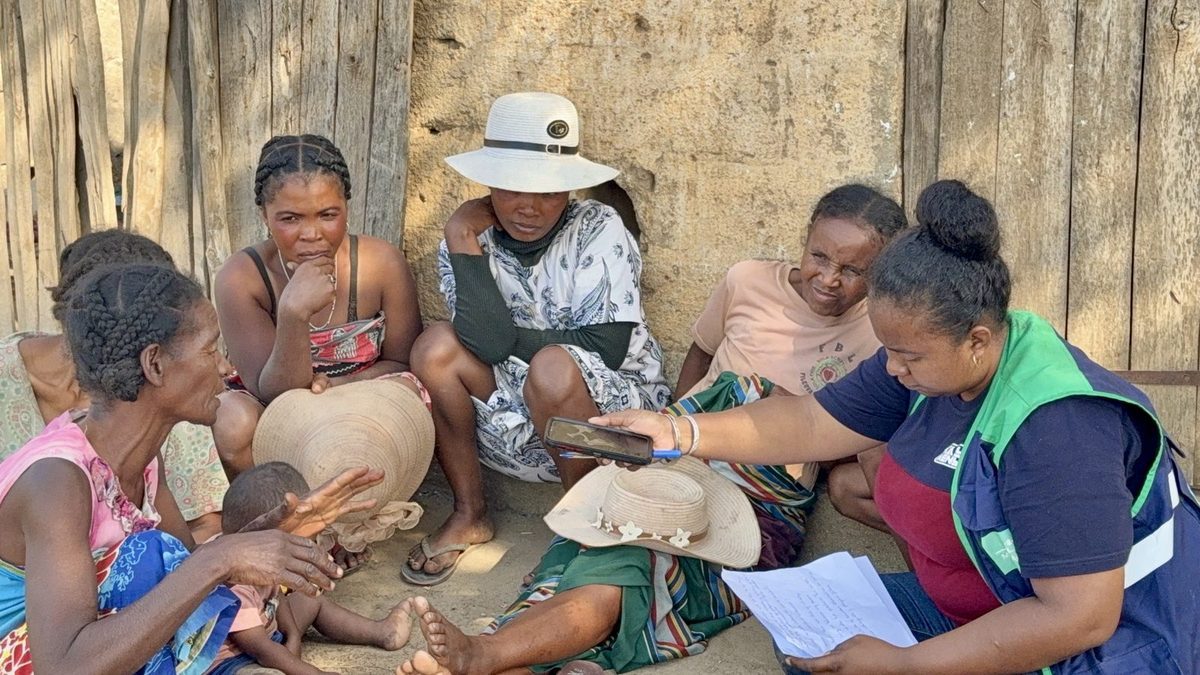
Tier 4, end-user groups. Below the fokontany sits the community itself, and this is where the FPIC standard really lives. SaniTap and MadAvance run consultation sessions with the households the project will reach, held in the local language (Malagasy and its regional dialects), scheduled at times when women can attend, structured to hear from women’s groups and youth groups separately from mixed-gender meetings, and documented with attendance registers and meeting minutes. Consent is recorded at this level. Without community-level consent, the project does not proceed.
The consultation meeting process, step by step
SaniTap runs its physical stakeholder consultation meetings to the exact process Gold Standard requires under its Stakeholder Consultation and Engagement Requirements, and applies the same discipline to every project we work on, whether Gold Standard registration requires it or not. The consultation record for each project is published on our own stakeholder consultations page and on the Gold Standard registry alongside the Project Design Document, during and after the process.
The eight steps below describe a single consultation cycle.
-
Public notice of the meeting. A written notice of the consultation is issued at the appropriate level for the project, national, regional or local as the case requires, and published on the SaniTap stakeholder consultations page so the consultation is open to anyone who wishes to attend or submit comments. The notice sets out the date, time, venue, purpose of the meeting, the project being consulted on, and how to attend or send comments. Notice is issued in Malagasy (and the local dialect where distinct) alongside the working language of the consultation, in advance of the invitations that follow.
-
Direct invitations to identified stakeholders. Named invitations are issued to the stakeholder groups the project affects: household representatives, women’s groups, youth groups, water committee members, fokontany elders, commune officials, and any civil-society organisation active in the area. The invitee list is documented and retained as part of the consultation record.
-
Follow-up invitations. A second-round invitation is issued to any group that has not confirmed attendance, and in particular to groups whose participation is essential (women’s groups, youth groups). The follow-up window is set to give people time to arrange their day; consultations that assume everyone can drop everything on twenty-four-hour notice systematically exclude women who carry household work.
-
The consultation meeting. The meeting is held in person in a location accessible to the community, in the local language, with translation if required. SaniTap or MadAvance presents the project (what it is, who it will reach, what it will do, what evidence supports it, what risks it carries, what alternatives were considered), and then the meeting is opened for discussion. Feedback, questions, objections and suggestions are captured in the meeting minutes. An attendance register is signed.
-
Written feedback register. All feedback received during the meeting, and any written feedback received via the fokontany or SaniTap channels in the days following, is compiled into a feedback register. Each item is timestamped and attributed (individual, women’s group, water committee, and so on).
-
First-round written response. SaniTap publishes a written response to every feedback item. Responses either accept the point and describe the design change made in consequence, or explain why the point cannot be accommodated. The response document is published on the stakeholder consultations page and shared with the fokontany.
-
Minimum thirty-day open consultation period. A further open consultation window of no fewer than thirty days is opened. During this window the meeting minutes, feedback register and first-round responses are published on the SaniTap stakeholder consultations page and, for Gold Standard projects, on the Gold Standard global stakeholder consultation platform. Anyone (household, community group, external observer) can submit further feedback.
-
Second-round written response. SaniTap publishes a second written response to every item received during the open consultation window. This response, together with the meeting minutes, the feedback register and the first-round response, forms the Stakeholder Consultation Report that is attached to the Gold Standard Project Design Document at registration.
The full record, meeting minutes, attendance register, feedback register, first-round response, open-consultation feedback and second-round response, remains publicly available on the stakeholder consultations page throughout and after the process. Nothing in the record is redacted for editorial convenience.
The eight-step process above is a minimum. On several projects SaniTap has run multiple rounds of consultation, further feedback windows, or additional women-only sessions where the first-round meeting did not achieve balanced participation. FPIC is a discipline that adapts to each project.
This applies to every SaniTap programme, without exception
The FPIC process applies to more than the flagship cookstove and safe-water strands. Every SaniTap intervention, at every stage of readiness, runs through the same standard.
Improved cooking. Household-level consultation for cookstove distribution focuses on the person at the stove (almost always a woman), the fuel-collection pattern (again, almost always women and girls), the household’s cooking practices, and their assessment of whether the offered stove design fits their meals and their kitchen space. The Anosy cohort of 90,241 households in Monitoring Report MP1 (2025) came through this process before the first stove was distributed.
Safe drinking water. Water-point rehabilitation and piped-system installation consultation runs at the settlement level: which source, which layout, who maintains it, how the water committee is constituted, how disputes over access get resolved. Because water infrastructure is inherently communal (a shared source, a shared maintenance obligation), FPIC here is doing more work than for individually-owned stoves.
Innovation projects. SaniTap’s innovation pipeline includes the RiverGuard riparian bamboo carbon sequestration pilot, biochar feasibility work, and the Cyclone-Resistant Safe Drinking Water Programme with its 241 candidate sites. Each new pilot goes through the same FPIC process as the core strands. RiverGuard, in particular, involves community land-use decisions (bamboo planting on riverbanks that communities use for other purposes), and no bamboo goes in the ground without the affected community having agreed to the project on their own terms.
Consulting engagements. When SaniTap’s consulting arm is engaged to support other organisations’ projects in Madagascar or elsewhere, we apply the same FPIC standard. The discipline travels with us.
FPIC and the gender-responsive standard, integrated by design
SaniTap runs at the gender-responsive level of the Gold Standard’s optional gender certification, one step above the mandatory gender-sensitive baseline. FPIC and gender-responsiveness are not separate compliance streams; they reinforce each other, and we run them together.
Women and girls are explicitly represented at every consultation tier. At the fokontany level, community meetings are structured to include separate women’s group sessions in addition to (not instead of) mixed-gender meetings, because in many rural Malagasy contexts women will not speak freely in a meeting dominated by senior male voices. Meeting minutes record women’s contributions separately, and design decisions are checked against them before the meeting closes.
The consultation timing works for women’s daily patterns. Meetings held in the middle of the day, when women are collecting water or cooking, exclude the very people the intervention most affects. SaniTap and MadAvance schedule sessions to fit women’s availability, not the field team’s convenience.
Girls are consulted through appropriate channels. For interventions that materially affect girls (water collection, cookstove use, health outcomes), we work with local schools and youth groups to hear from adolescent girls directly, not only through their mothers.
The consent record reflects gender balance. An attendance register that shows a consultation reached only men is not evidence of community consent, no matter how many signatures it carries. Our documentation practice makes gender balance visible at the consent record level.
The linked article on gender-responsive project design sets out the wider framing of why we chose this standard. FPIC is one of the ways we make it real.
The grievance channel, why FPIC does not stop at design freeze
Consent given at design freeze can become consent withdrawn if the project is implemented differently, or if unforeseen impacts emerge, or if the community’s circumstances change. SaniTap runs an open grievance channel through the entire crediting period so that a community can raise a concern at any point, and every case is logged, investigated, and responded to.
Practically, the grievance channel operates through the fokontany-level contact, the commune-level project coordinator, and a direct SaniTap contact route. Grievances get a timestamped record, an assigned investigator, and a defined response window. The grievance log is auditable and forms part of the Gold Standard monitoring record.
This matters because FPIC is not a one-off event. Consent that has to be maintained is more durable than consent that is only ever measured at the start.
What a buyer, an auditor or a regulator can rely on
A carbon buyer, a third-party verifier, or a regulator asking about SaniTap’s FPIC process can rely on the following:
Documented consultation record. Every project has a stakeholder consultation report attached to its Gold Standard Project Design Document, publicly available on the Gold Standard registry. These records are audited by the Validation and Verification Body at registration and re-audited at each monitoring cycle.
Ongoing consultation record. Post-registration consultation, meeting minutes, grievance log, community feedback, is retained and made available on request. Buyers with due-diligence questions on any specific site can request the underlying record.
Independent verification. The Validation and Verification Body checks that consultation was conducted in line with the Gold Standard requirements at both validation and each subsequent verification. The VVB’s report is public.
Alignment with international standards. Because SaniTap’s FPIC process is designed to meet Gold Standard, IFC PS7 and Cancun Safeguards, buyers whose own frameworks reference any of these standards can rely on the same underlying evidence.
Further reading
- UN Declaration on the Rights of Indigenous Peoples, UN Permanent Forum on Indigenous Issues site.
- ILO Convention 169, International Labour Organization.
- IFC Performance Standard 7 on Indigenous Peoples, IFC Environmental and Social Performance Standards.
- UNFCCC Cancun Safeguards, UNFCCC REDD+ safeguards.
- Gold Standard FPIC requirements, Gold Standard for the Global Goals.
- SaniTap’s stakeholder consultations page links to the project-specific design consultation documents on the Gold Standard registry.
- SaniTap’s gender-responsive project design explains the integrated gender programme referenced above.
United Nations (2007). United Nations Declaration on the Rights of Indigenous Peoples. Adopted by General Assembly Resolution 61/295, 13 September 2007. ↩︎
International Labour Organization (1989). Indigenous and Tribal Peoples Convention (No. 169). Adopted 27 June 1989; entered into force 5 September 1991. ↩︎
International Finance Corporation (2012). Performance Standard 7: Indigenous Peoples. Part of IFC’s Environmental and Social Performance Standards, effective 1 January 2012. ↩︎
UNFCCC (2010). The Cancun Agreements, Decision 1/CP.16, Appendix I: Guidance and safeguards for policy approaches and positive incentives on issues relating to reducing emissions from deforestation and forest degradation in developing countries. ↩︎
The Gold Standard (2019). Stakeholder Consultation & Engagement Requirements, part of the Gold Standard for the Global Goals framework. ↩︎
Verra. VCS Standard and Climate, Community & Biodiversity Standards, both include FPIC requirements for affected communities. ↩︎